The Era of Instinct-Driven Businesses Is Over
For decades, many small businesses in Nigeria were built on instinct.
Entrepreneurs relied on:
- Experience
- Market familiarity
- Word-of-mouth trends
- Personal judgment
And in less competitive environments, that worked.
But today’s Nigerian economy is different. Rising operational costs, currency volatility, increased competition, and digital marketplaces have changed the game. Modern SMEs operate in a data-rich environment. Every transaction, sale, click, and customer interaction generates measurable information.
Here’s the reality: Feelings may start businesses, but Data scales them. Successful businesses run on numbers, not emotions.
What Are Data-Driven Decisions?
Data-driven decisions are business choices guided by measurable insights rather than assumptions. Instead of asking: “I feel like this product is selling well.” You ask: “What does the sales report show over the last 30 days?”
Data-driven decisions involve:
- Tracking key performance indicators (KPIs)
- Measuring revenue trends
- Monitoring expenses
- Analyzing customer behavior
- Forecasting future performance
For Nigerian SMEs, this means replacing guesswork with structured SME growth strategies backed by real numbers.
Why Guesswork Slows SME Growth
Guesswork creates invisible risks. And invisible risks eventually become visible losses.
1. Poor Pricing Decisions
Without margin analysis:
- Products may be underpriced
- Inflation erodes profit
- Discounts reduce sustainability
Many SMEs in Nigeria increase sales volume but struggle with profitability because pricing decisions aren’t based on data.
2. Inefficient Marketing Spend
Running Instagram or Facebook ads without tracking:
- Cost per acquisition
- Conversion rate
- Return on investment
Leads to wasted capital.
Marketing without data is gambling.
3. Inventory Mismanagement
Common inventory issues among Nigerian SMEs:
- Overstocking slow-moving items
- Running out of bestsellers
- No visibility into product performance
Without tracking inventory turnover, capital gets locked in dead stock.
4. Cash Flow Surprises
Revenue does not equal profit.
Without structured financial reporting:
- Expenses go unnoticed
- Cash flow becomes unpredictable
- Growth becomes unstable
Cash flow visibility is one of the most critical SME growth strategies.
The Core Metrics Every Nigerian SME Should Track
Authoritative businesses track numbers consistently.
Here are the essentials:
Revenue Growth Rate
Measures how fast your business is expanding month-over-month.
Customer Acquisition Cost
How much it costs to gain one new customer.
Customer Retention Rate
How many customers return to buy again.
Profit Margins
The actual percentage you keep after expenses.
Inventory Turnover
How quickly stock converts into revenue.
Cash Flow Position
The money available to sustain operations.
These metrics transform business decisions from reactive to strategic.
How Data-Driven Decisions Accelerate SME Growth Strategies
When SMEs adopt data-driven decisions, growth becomes intentional.
Here’s what changes:
- Pricing becomes optimized
- Marketing becomes measurable
- Inventory becomes efficient
- Expenses become controlled
- Expansion becomes strategic
Instead of hoping for growth, you engineer it.
Data allows you to:
- Identify best-performing products
- Predict seasonal demand
- Allocate resources effectively
- Reduce operational waste
- Improve customer lifetime value
This is how small businesses grow faster than competitors relying on instinct alone.
A Real-World Scenario – Guesswork vs Data
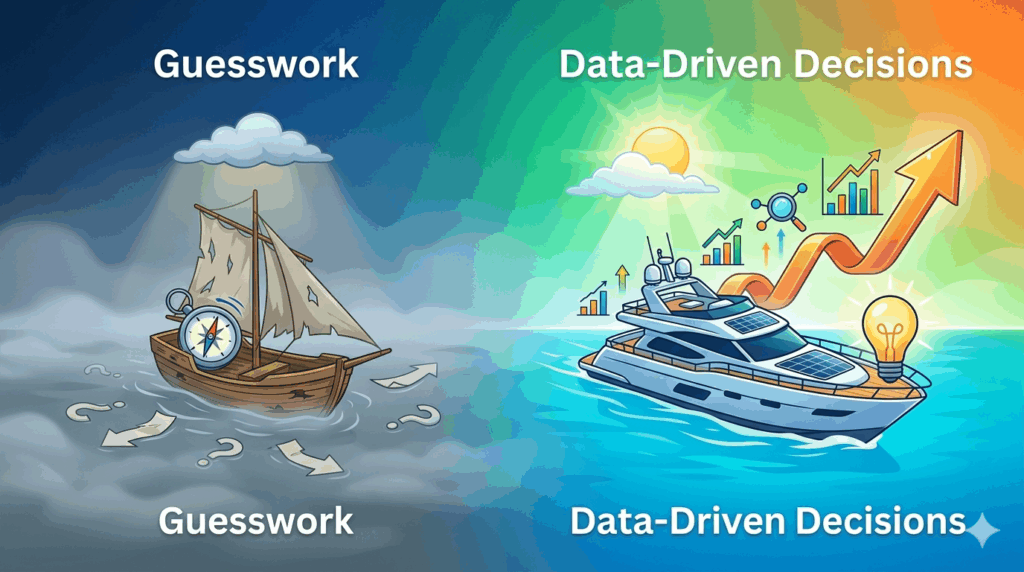
Consider two Lagos-based retail businesses.
Business A:
- Tracks sales manually
- Prices based on competitor assumptions
- No clear expense reporting
- No structured analytics
Business B:
- Uses analytics dashboards
- Monitors weekly revenue trends
- Tracks inventory turnover
- Reviews financial reports monthly
After 12 months: Business A experiences inconsistent cash flow and unpredictable growth. Business B identifies its top 20% best-selling products, reallocates marketing budget efficiently, optimizes pricing, and increases profitability steadily. The difference isn’t luck. It’s data-driven decisions.
Turning Numbers Into Growth

Many Nigerian SMEs struggle not because they lack effort, but because they lack visibility. Timart transforms raw business activity into structured insights by providing:
- Automated sales reports
- Real-time financial dashboards
- Inventory analytics
- Customer performance tracking
- Growth forecasting tools
Instead of scattered records and assumptions, businesses get centralized reporting and actionable analytics. From raw data to real decisions. That’s how structured SME growth strategies are built.
How to Start Making Data-Driven Decisions Today
You don’t need a large corporation to think like one.
Start with these steps:
- Track daily sales consistently
- Record every expense
- Monitor weekly revenue trends
- Review inventory movement monthly
- Use integrated reporting tools for visibility
Consistency turns information into insight.
Insight turns strategy into growth.
Frequently Asked Questions (FAQ)
What are data-driven decisions in business?
They are decisions based on measurable insights such as sales reports, profit margins, and customer metrics rather than assumptions.
Why are data-driven decisions important for SMEs in Nigeria?
They reduce financial risk, improve profitability, optimize inventory, and support structured growth in a competitive market.
How can small businesses use business analytics?
By tracking KPIs, reviewing performance reports regularly, and using centralized dashboards to monitor operations.
What tools support SME growth strategies?
CRM systems, financial reporting tools, inventory management software, and integrated analytics platforms.
Is data analysis expensive for small businesses?
Not anymore. Modern SME-focused platforms provide affordable reporting and analytics designed specifically for growing businesses.
Final Thoughts – Growth Is Measurable
Guesswork creates volatility. Data creates clarity. In today’s Nigerian business environment, competition is intense and margins are tight. SMEs that rely on instinct alone will struggle to scale sustainably, but those that embrace data-driven decisions will:
- Grow faster
- Reduce risk
- Improve profitability
- Scale with confidence
successful businesses do not run on feelings. They run on numbers.