The Current Reality of Record Keeping for Small Businesses in Nigeria
Record keeping for small businesses in Nigeria is still largely manual. From roadside shops to growing SMEs, notebooks, loose papers, and mental calculations remain the dominant system. While this approach feels familiar and inexpensive, it quietly creates long-term damage.
Many business owners believe manual records give them control. In reality, they create blind spots. When sales are written in haste, expenses are forgotten, and receipts are misplaced, the business slowly loses track of its own performance. This is not just a bookkeeping issue—it’s a survival issue.
How Manual Records Became the Default System
Manual record keeping became popular because it required no training, no electricity, and no internet. For years, it worked “well enough.” But as competition increases and margins shrink, “well enough” is no longer enough.
Cultural Trust in Notebooks, Memory, and Experience
Many Nigerian SMEs rely heavily on memory and experience. While experience is valuable, memory is unreliable. As transaction volume grows, mental tracking collapses under pressure.
The Hidden Costs of Manual Record Keeping Most SMEs Ignore
Manual systems appear cheap on the surface, but they are expensive in ways most owners don’t calculate.
Revenue Leakages and Financial Blind Spots
Without accurate records, business owners cannot see where money is going. Small losses add up.
Missing Sales, Inaccurate Expenses, and Cash Flow Confusion
- Sales are forgotten or under-recorded
- Expenses are mixed with personal spending
- Profit is guessed, not calculated
This confusion makes it impossible to plan or grow.
Time Wastage and Productivity Loss
Searching through old notebooks, rewriting damaged pages, and reconciling figures manually wastes hours every week—time that could be spent selling or improving operations.
Common Errors Caused by Pen-and-Paper Systems
Human Error, Data Loss, and Inconsistency
Manual entries are prone to:
- Calculation mistakes
- Double entries
- Lost or damaged books
Once data is lost, it is gone forever.
Difficulty Tracking Inventory and Customers
Without structured records, stock levels are guessed. This leads to overstocking, stockouts, and unhappy customers. Customer histories disappear, making repeat sales harder.
Why Manual Record Keeping Is Holding Back Business Growth
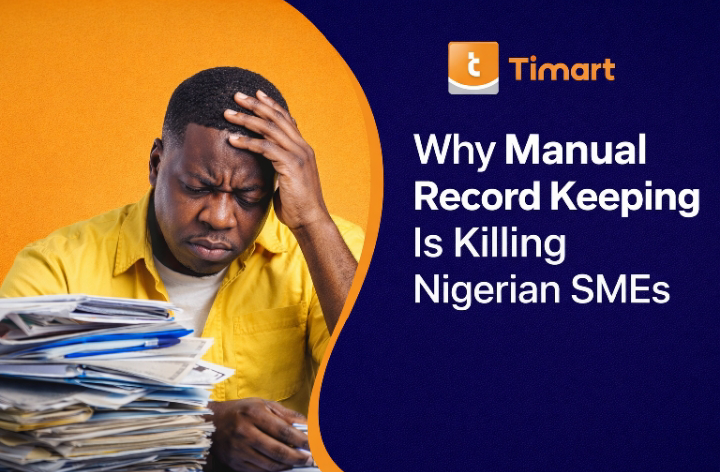
Poor Decision-Making Without Real Data
When records are inaccurate, decisions are based on feelings, not facts. Owners cannot answer simple questions like:
- Which product sells best?
- Which customer brings the most revenue?
- Which expense is draining profit?
Inability to Access Loans or Investors
Banks and investors require clear financial records. Businesses using notebooks struggle to prove income, expenses, and stability. This blocks access to funding.
The Rise of Business Management Tools Nigeria SMEs Are Adopting
Today, business management tools Nigeria entrepreneurs use are changing the game. Digital systems replace guesswork with clarity.
What Digital Record Keeping Looks Like Today
Modern tools offer:
- Sales tracking
- Expense management
- Inventory control
- Customer records
All stored securely and accessible anytime.
Automation, Accuracy, and Real-Time Insights
Automation removes human error. Reports are generated instantly. Business owners finally see the full picture of their operations.
Timart’s Approach: From Chaos to Control
Timart is designed specifically for Nigerian SMEs transitioning from manual chaos to smart systems.
Digital Records and Automated Business Operations
With Timart:
- Records are stored digitally
- Invoice reminders, debt reminders and inventory management process like expiring date alert, low product alert, can be automated
- Reports are generated without stress
Reduced Errors and Peace of Mind for Business Owners
Instead of worrying about missing books or incorrect figures, owners gain confidence. Peace of mind becomes a daily benefit, not a luxury.
FAQs About Record Keeping for Small Businesses in Nigeria
1. Why is record keeping important for small businesses?
It helps track profit, control expenses, and make informed decisions.
2. What are the risks of manual record keeping?
Errors, lost data, revenue leakage, and poor financial visibility.
3. Are digital tools expensive for Nigerian SMEs?
Many tools are affordable and cost far less than the losses caused by poor records.
4. Can small businesses use digital tools without accounting knowledge?
Yes. Most modern tools are built for non-accountants.
5. How do business management tools Nigeria SMEs use improve growth?
They provide accurate data, automation, and insights that support scaling.
6. Is Timart suitable for very small businesses?
Yes. It is designed to grow with the business from small to large operations.
Conclusion: From Survival Mode to Smart Systems
Manual record keeping is no longer a harmless habit, it is a silent business killer. Nigerian SMEs that continue to rely on pen and paper face avoidable losses, stress, and stagnation. By embracing record keeping for small businesses through modern business management tools Nigeria entrepreneurs trust, owners move from survival mode to structured growth.
The shift from notebooks to smart systems is not about complexity. It is about control, clarity, and peace of mind. And tools like Timart make that transition possible.