The Rise of WhatsApp Businesses in Nigeria
Nigeria is one of Africa’s largest mobile-first economies. With over 200 million citizens and widespread smartphone adoption, social commerce has exploded, and WhatsApp Business has become the default operating system for many small businesses. From vendors in Lagos to those in Abuja, thousands of SMEs run daily operations entirely from WhatsApp chats.
Why?
- Low startup cost
- Easy customer access
- No technical setup required
- Familiar interface
- Fast communication
For early-stage businesses, it works. But as businesses grow, cracks begin to show.
WhatsApp Business Limitations Nigerian SMEs Ignore
WhatsApp is powerful for communication. But communication is not infrastructure. Here are the biggest WhatsApp business limitations affecting SME tools Nigeria adoption:
1. No Centralized Customer Database
When customers are buried in chats:
- No structured customer history
- No lifecycle tracking
- No segmentation
- No automated follow-ups
If a staff member leaves, customer history often leaves with them. There is no true CRM system, only message threads.
2. Chats Are Not Sales Pipelines
A sales pipeline answers:
- Who is interested?
- Who has paid?
- Who needs follow-up?
- What stage is each lead in?
WhatsApp does not track:
- Conversion rates
- Lead sources
- Sales performance metrics
- Follow-up reminders
Without measurable data, scaling becomes guesswork.
3. Inventory Chaos
Many Nigerian SMEs track stock in:
- Notebooks
- Memory
- Excel sheets
- Chat confirmations
This leads to:
- Overselling
- Stockouts
- Missed reorder timing
- Revenue loss
Without real-time inventory management, growth increases errors.
4. No Financial Visibility
Scaling requires financial clarity.
WhatsApp does not provide:
- Profit tracking
- Expense monitoring
- Cash flow analysis
- Revenue dashboards
Many SMEs know sales volume, but not actual profit margins. That’s a dangerous position for a growing business.
5. Team Scaling Problems
As SMEs grow beyond one founder:
- Multiple staff reply from one device
- Messages get mixed up
- No accountability tracking
- Customer complaints increase
Without role-based access and structured workflows, team expansion creates operational chaos.
Why Chats Don’t Equal Systems
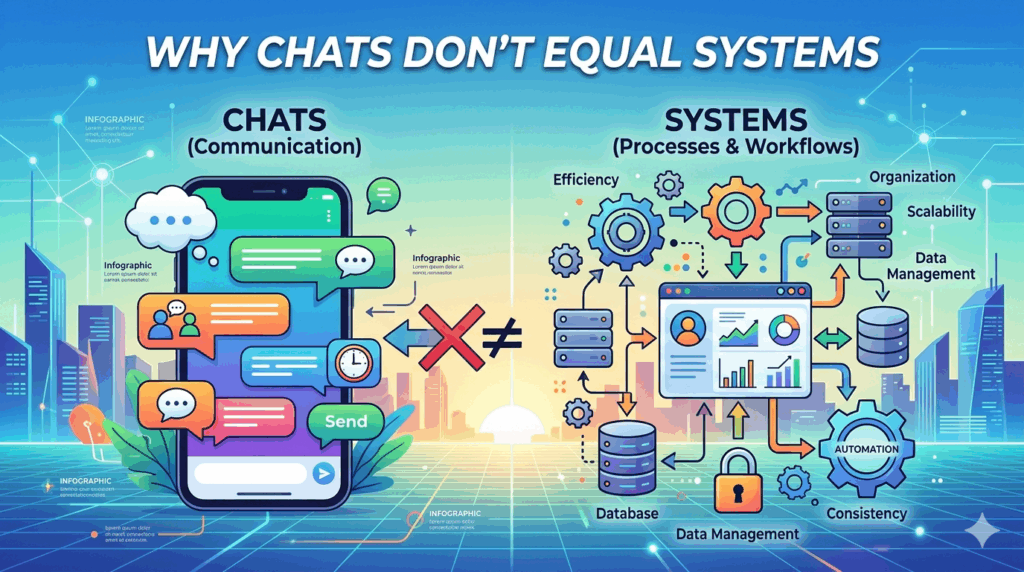
Here’s the fundamental issue: A chat is reactive. A system is proactive.
A chat:
- Waits for messages
- Depends on memory
- Stores unstructured information
A system:
- Tracks leads automatically
- Records financial data
- Generates reports
- Sends reminders
- Forecasts growth
Scaling requires repeatability. Repeatability requires systems, and systems require proper SME tools Nigeria businesses can rely on.
The Essential SME Tools Nigeria Businesses Need to Scale Properly
To move beyond WhatsApp business limitations, SMEs need structured tools:
1. Customer Relationship Management (CRM)
A CRM allows businesses to:
- Track every customer interaction
- Monitor lead stages
- Segment repeat buyers
- Automate follow-ups
- Improve retention
Retention is cheaper than acquisition, yet most WhatsApp-only businesses cannot measure it.
2. Inventory Management Tools
Structured inventory systems provide:
- Real-time stock updates
- Low-stock alerts
- Reorder forecasting
- Product performance reports
This prevents revenue leakage caused by manual tracking.
3. Financial Management Software
Financial tools give:
- Expense tracking
- Revenue dashboards
- Profit margin insights
- Cash flow forecasting
Without visibility, growth is blind.
4. Workflow & Team Management
As teams grow, systems should provide:
- Role-based access
- Task assignment
- Performance tracking
- Customer service logs
This improves accountability and reduces errors.
5. Unified Business Dashboard
The real power comes when: CRM + Inventory + Finance + Team workflows are integrated into one dashboard. That’s when a business stops “hustling” and starts scaling.
Structured Business Management Beyond Messaging
WhatsApp helps you talk to customers. Timart helps you run your business. Instead of scattered chats, Timart provides:
- Centralized customer management
- Real-time inventory tracking
- Financial performance dashboards
- Real-time Reports for Data-Driven decisions
Designed specifically for Nigerian SMEs, it bridges the gap between informal selling and structured enterprise growth. It transforms: Chat-based hustle → System-based scale.
What Happens When Nigerian SMEs Implement Proper Systems
When SMEs move beyond WhatsApp-only operations, they experience:
- Higher customer retention
- Reduced operational errors
- Clear financial visibility
- Easier delegation
- Predictable growth
Scaling becomes strategic, not stressful.
Frequently Asked Questions (FAQ)
- Is WhatsApp Business enough for a small business in Nigeria?
It may work for early-stage startups, but it lacks structured CRM, inventory, financial tracking, and team management capabilities required for scaling.
- What are the biggest WhatsApp business limitations?
Lack of customer database, no sales pipeline tracking, no financial dashboards, limited team collaboration, and no automation.
- What SME tools Nigeria businesses need to scale?
CRM systems, inventory management software, financial tracking tools, workflow management systems, and unified dashboards.
- How can I manage inventory beyond WhatsApp?
By using inventory management software that tracks stock in real-time and integrates with your sales system.
- Why are systems important for small businesses?
Systems create repeatability, data visibility, accountability, and scalability.
Growth Requires Systems, Not Just Sales Chats
WhatsApp is a communication tool. It is not a business management system. If your SME depends entirely on chats, your growth will eventually stall. To scale properly in Nigeria’s competitive market, businesses must move from conversations to coordination, from messaging to management.
Ready to Move Beyond WhatsApp?
If you’re serious about scaling:
? Book a demo with Timart
? Explore how structured systems can simplify your operations
? Start a free trial and experience organized growth
Stop running your business in chats. Start running it on systems.